For 86 years, Indiana crowned exactly one state high school basketball champion. One trophy, one bracket, and every school in the state — from Indianapolis giants to towns with a couple hundred kids in the whole building — chasing the same title. Then, in 1997, the IHSAA class system replaced all of that, and Indiana basketball has never fully stopped arguing about it since.
Life Before the IHSAA Class System
The tournament itself dates to 1911, when it was organized as a single-class event at Indiana University’s original Assembly Hall. Crawfordsville won that first championship, and for the better part of a century, the format barely changed: sectionals fed into regionals, regionals into semistates, semistates into a single state final, with every school in Indiana — regardless of size — thrown into the same bracket. The finals moved to Hinkle Fieldhouse at Butler University in 1928 and stayed there for 41 years, a run that turned the building into hallowed ground for generations of Hoosier fans.
That single-class format is also what made Indiana basketball a national story. In 1954, tiny Milan High School — enrollment 161 — beat powerhouse Muncie Central for the state title, a run so improbable it became the basis for the movie “Hoosiers” three decades later. Two years after that, Indianapolis Crispus Attucks, led by a young Oscar Robertson, won back-to-back titles under coach Ray Crowe, becoming the first all-Black school to win a state championship in the country. Those moments are exactly why the pre-1997 format still gets romanticized today: any school, in theory, could beat anybody.
Why the IHSAA Class System Replaced the Old Format
By the mid-1990s, that theory had worn thin for a lot of administrators. Big schools with deeper talent pools were winning most of the hardware, and small-school principals had spent years pushing for a structure that gave their programs a realistic shot at a championship. On April 29, 1996, the IHSAA Board of Directors voted 12-5 to approve a multi-class tournament format for team sports, effective with the 1997-98 school year — the vote that formally created the IHSAA class system Indiana basketball has used ever since.
It wasn’t uncontested. Opponents of the change gathered enough signatures — 20 principals in each of the state’s five legislative districts — to force a statewide referendum among member schools. When the ballots were counted by that September, the board’s decision was upheld, 220 votes to 157. Bloomington North went on to win the final single-class state championship that spring, closing the book on an 86-year era before the four-class system took over the following season.
How the New Structure Actually Worked
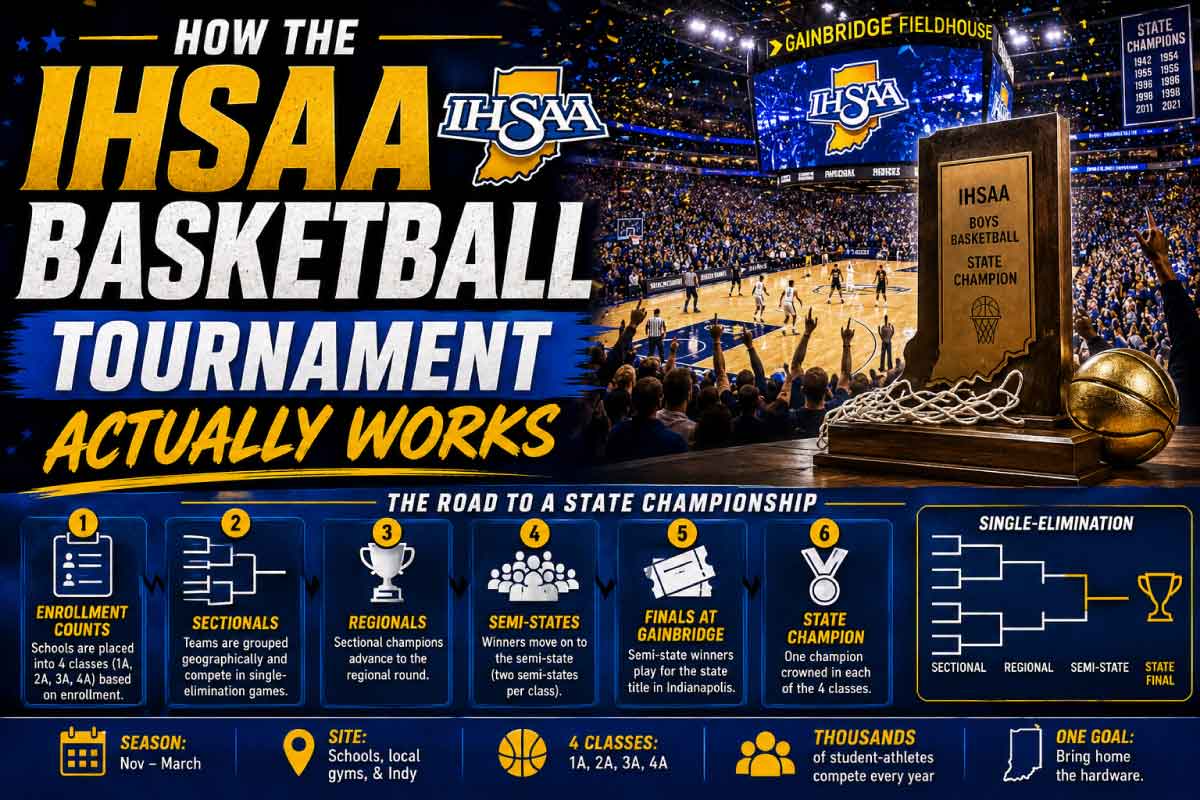
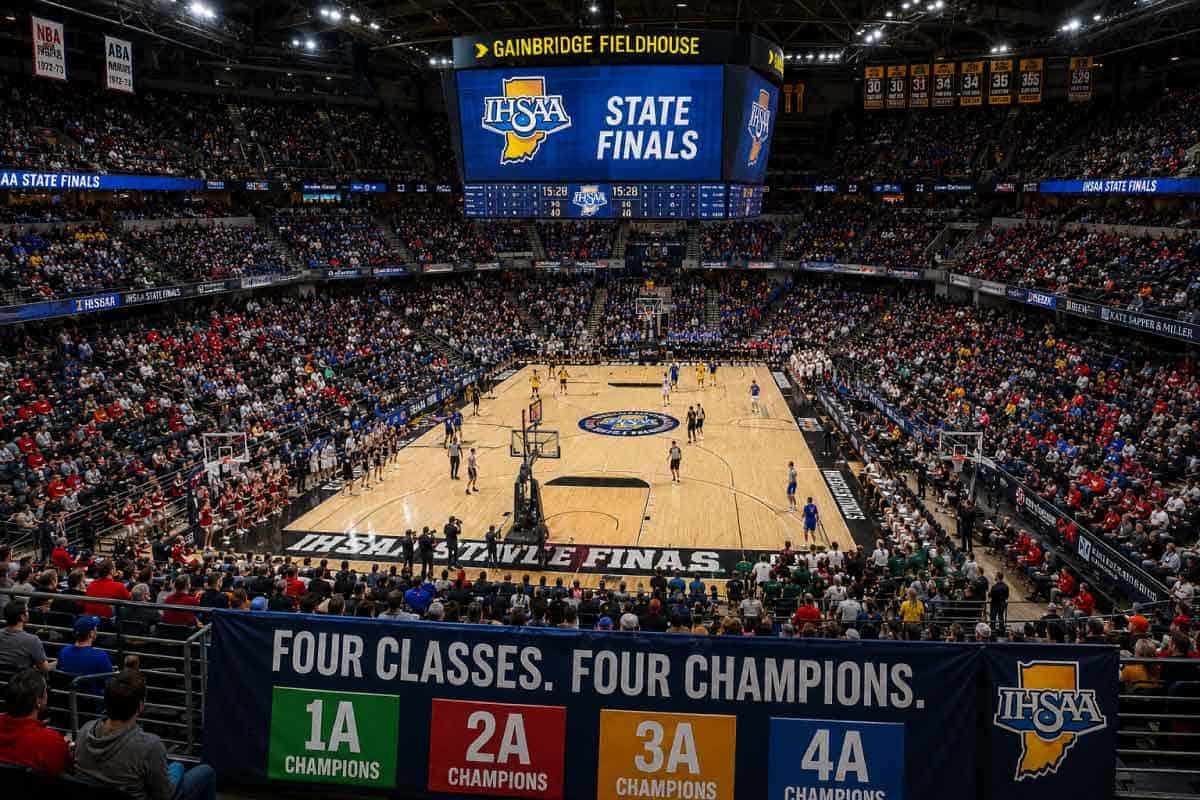
The IHSAA split its roughly 384 member basketball schools into four enrollment-based classes — 1A through 4A — with each class initially covering about a quarter of all schools statewide, from smallest to largest. Every class got its own full bracket: sectionals, regionals, semistates, and a state championship game, meaning four separate champions were crowned instead of one. State finals eventually moved from Assembly Hall in Bloomington to what’s now Gainbridge Fieldhouse in Indianapolis, where all four class championships are still played across a single weekend in late March.
There was one short-lived experiment tacked onto the very first year of the new system: the Tournament of Champions, an exhibition pitting the four class champions against each other to settle, unofficially, who the “best” team in the state really was. It lasted exactly two seasons. The first one wasn’t close — Class 4A champion Pike routed Class A champion Lafayette Central Catholic by 43 points, which did more to undercut the “any class could win it all” argument than support it, and the event quietly disappeared.
The Fix Nobody Saw Coming: Tournament Success Factor
One criticism that stuck around for years was that the new class system just shifted the old dynasty problem down a level — instead of one dominant big school, you’d get one dominant small school running through the same lower class year after year. The IHSAA responded in the early 2010s with the Tournament Success Factor, a rule that bumps a program up one class for two years if it wins enough championships or racks up enough tournament advancement — historically defined as three state titles or six semistate appearances within a four-year window. It’s a targeted patch on the IHSAA class system rather than a structural overhaul, designed to keep any one small school from stacking titles indefinitely in a class built for schools its own size.
The Debate That Never Really Ended
Twenty years after the switch, longtime coaches were still split right down the middle. Bill Green, who won six championships in the old single-class format — five of them at Marion — put it about as bluntly as anyone: “the IHSAA took the state out of state finals. Nobody wins a state title now, only class titles.” Fort Wayne coach Jack Keefer, who won titles under both formats, has said much the same thing about missing the old community energy that came with a small school taking a real shot at the big boys.
On the other side, former IHSAA leadership has defended the switch on pure numbers. Under the old single-class format, the vast majority of schools genuinely had no realistic path to a championship — the IHSAA class system gave hundreds of smaller programs an actual shot at hardware for the first time in the tournament’s history. Indianapolis Star reporter Kyle Neddenriep has noted that fan interest and attendance measurably dipped after the change, even as more schools got to celebrate a title of their own.
Where Things Stand Today
Nearly three decades in, the four-class basketball format shows no sign of reverting. Classes are re-certified every two years using enrollment data, schools can petition to “play up” a class if they choose, and the Tournament Success Factor continues to nudge repeat winners upward. Football, notably, runs its own separate structure entirely — it adopted a single-class tournament back in 1973 before expanding to multiple classes and eventually growing to six classes today, a completely different evolution from the basketball side of the IHSAA class system.
For fans who remember Milan ’54 and the Crispus Attucks dynasty, the old single-class tournament still represents something the four-class era can’t fully replicate — the pure, any-given-Tuesday chaos of a 161-student school beating the state’s biggest power. For everyone else, the IHSAA class system means more schools, more communities, and more players who get to say they were part of a state championship team. Both things are true at once, and that’s exactly why the argument has never really gone away.