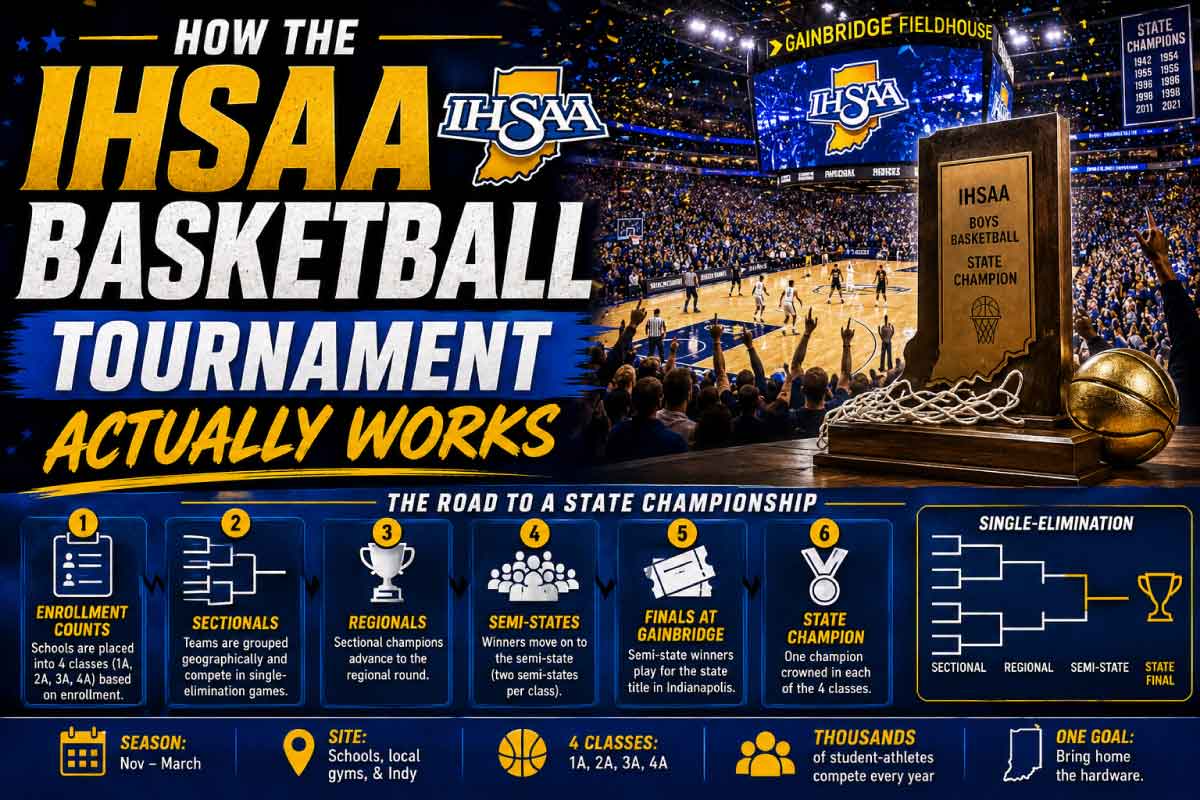
Ask someone from Ohio how their state tournament seeding works and they’ll probably shrug. Ask a Hoosier, and you’ll get an opinion — usually a strong one, often with a story attached about 1997. Indiana doesn’t do this tournament like everybody else, and understanding why takes about four minutes.
Four Classes, Not One Bracket
Every team enters one of four classes — 1A, 2A, 3A, or 4A — sorted by enrollment, smallest schools to largest. This year, 404 boys’ teams entered across the state: 122 in 1A, 100 in 2A, 100 in 3A, and 82 in 4A. That’s four completely separate tournaments running at once, each crowning its own champion. It hasn’t always worked this way, and we’ll get to that.
Sectionals: 64 Brackets, No Seeds, No Mercy
The tournament opens with 64 sectionals — 16 per class — and this is where Indiana does something almost nobody else does anymore: it doesn’t seed anything. Every school gets tossed into a lottery-style machine, balls get blown up through a tube in random order, and whatever comes out is the bracket. First ball out plays the visitor role in game one, second ball is the home team, and so on straight through all 64 brackets. A undefeated 4A power could theoretically draw the toughest team in its sectional round one. That’s the deal, and it’s been the deal for over a century.
Sectionals run Tuesday through Saturday in early March. Win yours, and you get a trophy that still means something in a town where the gym seats more people than live downtown.
Regionals: Two Games, One Site, Survive and Advance
Sixteen sectional champions per class move on to eight regionals — again unseeded, again a blind draw, with two regional championship games assigned to each host site (not necessarily from the same class). Win your regional, and you’re one of 16 teams left standing statewide in your class. Lose, and the season’s over, no matter how good your regular season looked on paper.
Semi-State: The Weekend Everything Gets Real
From here it’s a two-game affair — four semi-state sites, two games apiece, winner advances. This is usually where the “great story” teams either cement their legend or get sent home a game short. It’s also, historically, the round where Cinderella runs from small-town Indiana either keep breathing or stop.
State Finals: One Building, One Saturday, Four Champions
All four classes settle everything on the same Saturday at Gainbridge Fieldhouse in downtown Indianapolis — a tradition that dates back to 2000, after more than two decades at Assembly Hall in Bloomington. Class games are split across two sessions so fans can, in theory, watch all four championships in one day if they’re willing to sit through the whole thing. Four brackets. Four trophies. One building, buzzing from morning tip to the last horn that night.
Why Older Fans Still Bring Up 1997
Here’s the part that actually explains why Indiana basketball conversations get heated: this four-class format is younger than plenty of the fans arguing about it. For 87 years, Indiana ran one tournament, no classes, every school in the state chasing the same trophy — the format that gave the world the Milan Miracle in 1954, when a 73-boy school beat Muncie Central on a last-second Bobby Plump shot and inspired a movie you’ve probably seen even if you’ve never watched a single sectional game.
That ended after a 1996 petition from 100 member schools and a board vote, followed by a referendum where principals statewide voted 220-157 to split basketball into four classes starting with the 1997-98 season. Bloomington North beat Delta for the final one-class championship in March 1997, and the next season Indiana crowned four separate champions for the first time — Pike, Indianapolis Cathedral, Alexandria, and Lafayette Central Catholic. The IHSAA even ran a short-lived “Tournament of Champions” afterward, pitting the four class winners against each other, but it only lasted two years before getting scrapped.
Nearly three decades later, the debate hasn’t really gone away — small-school administrators generally like the access the class system gives their kids, while a lot of longtime fans still miss the version where every single school, no matter the size, had a real shot at the exact same trophy. Both sides have a point. That tension is basically baked into every March in this state now.
Whatever side of the class-basketball debate you land on, the format above is what’s actually being played right now, every March, in gyms from the smallest 1A towns to the biggest 4A arenas.