The IHSAA transfer rule used to be simple in the worst way: you moved schools, you sat out a year. All three sports seasons, gone, no matter why you switched. That changed in 2025, and a lot of Indiana families still don’t fully understand what replaced it.
What Rule 19 Actually Says Now
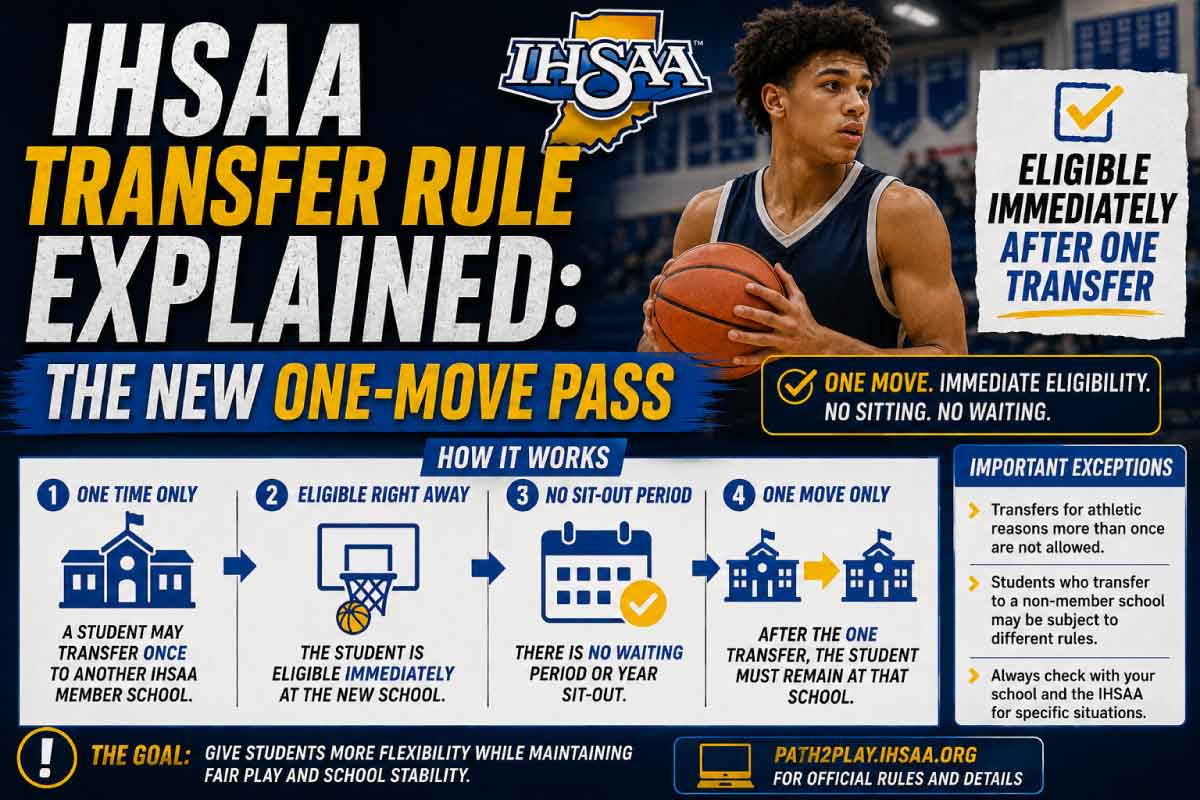
Rule 19 covers eligibility and transfers for every IHSAA member school, and the version that took effect June 1, 2025, rewrote the part everybody actually cares about. A student’s first transfer between two IHSAA member schools now comes with full, immediate eligibility — no waiting period at all — as long as it happens within the athlete’s first six semesters of high school. Freshman year, sophomore year, first semester junior year: covered. Wait past that window, and the old rules start applying again.
That’s a genuine one-time pass. One free move, play right away, no questions asked about motive.
What Happens on a Second Transfer
Here’s where it gets specific. If a student’s second move is actually a return to the school where they first established eligibility — and it happens within 365 days of when they originally enrolled at the school they’re now leaving — they keep full eligibility on that return trip too. Move somewhere else and come back inside a year, and the rule treats it like you never really left.
Any other second transfer, though, or a transfer coming from a school that was never an IHSAA member in the first place, gets handled the old way — under review, subject to the “primarily athletic reasons” test that’s governed Indiana transfers for years.
The “Primarily Athletic Reasons” Test Didn’t Go Away
This is the part people forget. The new one-transfer pass doesn’t erase the underlying eligibility rule — it just gives a first mover a clean exemption from it. Outside that exemption, a transfer still has to clear a basic test: it can’t be primarily about athletics. The IHSAA already recognized several built-in exceptions before 2025, and they’re still in play. A student stays eligible if the prior school wasn’t an IHSAA member or wasn’t accredited, if they sat out all school and club competition for a full 365 days before enrolling, if the family moved and the student is returning to a school they’d previously attended, or if a parent or guardian just took a licensed or certified staff position at the new school. Miss all of those exceptions and fall outside the one-move pass, and a year-long sit-out is still very much on the table.
There’s a companion rule worth knowing too — Rule 20, on undue influence. Even a technically legal transfer can get flagged if someone recruited the student specifically to land them at a new school for sports. That rule hasn’t changed, and it applies regardless of whether Rule 19 grants the transfer automatic eligibility.
Why the IHSAA Changed It
The short version: state politics forced the issue. Indiana lawmakers pushed House Bill 1064, aimed at loosening restrictions on students enrolling in schools “primarily for athletic reasons,” and it cleared the state House by a 67-25 vote. Rather than wait to see what the legislature might impose, the IHSAA’s Executive Committee built its own framework and approved it in February 2025 — a rule that, by the association’s own count, had already been rewritten 26 separate times since the 2012-13 school year. This version is meant to hold longer than most of those did.
Worth remembering while all this plays out: the IHSAA itself is a voluntary, self-supporting nonprofit with roughly 409 member schools, running state tournaments across 24 sports without collecting a dime in tax money or membership fees. Every rule change like this one gets hashed out by member-school representatives, not handed down from some outside authority — which is exactly why Rule 19 keeps getting rewritten. The people voting on it are the same athletic directors and principals dealing with its consequences every fall.
Whether it actually holds is a different question. Every version of Rule 19 has eventually run into the same tension — schools that lose a good player call it recruiting, schools that gain one call it school choice — and this one is unlikely to be the exception.