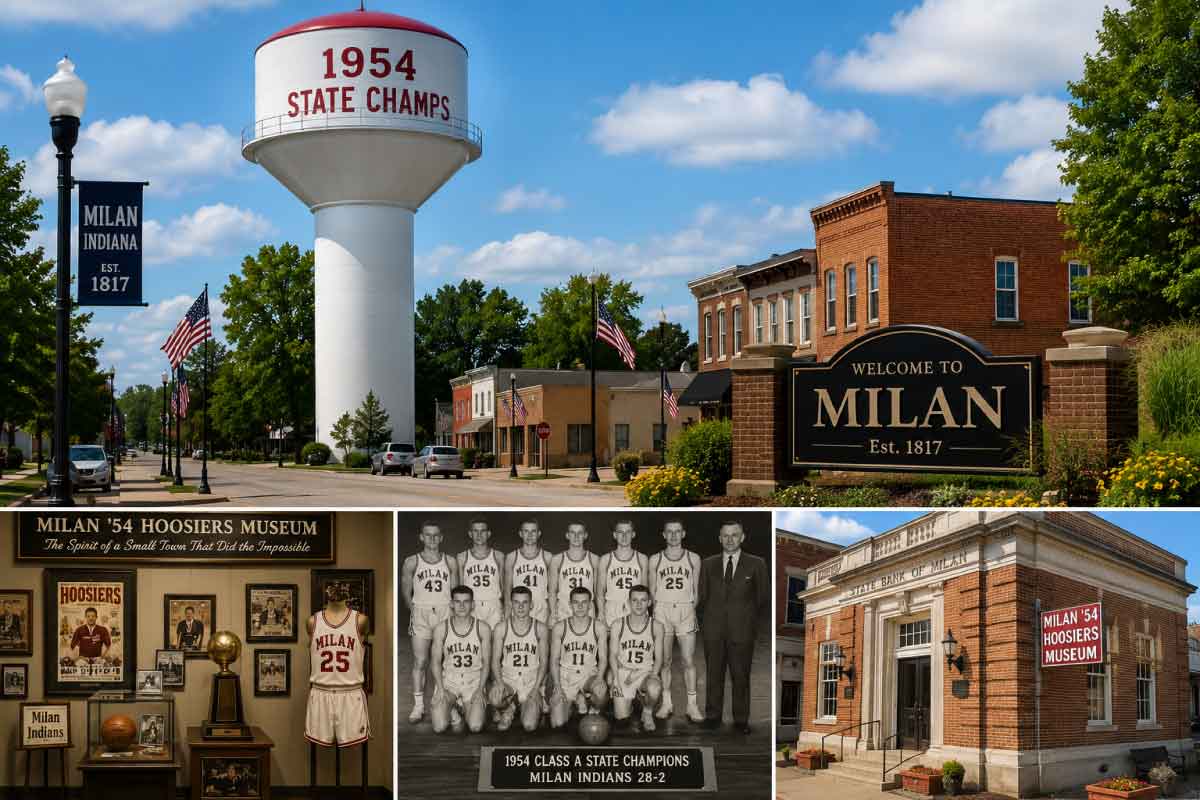
The water tower still says it. Drive into town on Indiana 101 and look up: “1954 State Champs,” repainted and unmistakable, hanging over a town that’s spent 72 years being defined by one basketball game. This is the real Milan 1954 Hoosiers town today — smaller than the movie made it look, and prouder of that game than any single town has a right to be about anything.
The Game That Made Milan 1954 a Hoosiers Town Forever
Here’s the part that still sounds made up: Milan High School had an enrollment of just 161 students in 1954. That’s not a typo, and it wasn’t unusual for the movie to exaggerate it, because the real number needs no help. Under a 24-year-old head coach named Marvin Wood — hired two years earlier in a controversial move after his predecessor was fired for ordering unauthorized uniforms — the Indians went 19-2 in the regular season and 28-2 overall, then did the impossible. They beat Muncie Central 32-30 at Hinkle Fieldhouse to win the Indiana state basketball championship, becoming the smallest school ever to win a single-class state title in Indiana history.
Bobby Plump hit the winning shot. He’s the reason “Jimmy Chitwood” exists in the movie version, and he’s still alive today, recently celebrating his 89th birthday and remaining one of the most recognizable figures connected to Indiana basketball history. Teammates Ray Craft and Gene White rounded out the core of that team, and forward William Jordan, who wore No. 4, went on to a genuine Hollywood acting career, appearing in films like “Kingpin” and “Contact” years after his playing days ended.
Coach Wood didn’t get to enjoy a long retirement telling the story. He died of lymphoma in 1999 at age 71, in Mishawaka. But the players he coached have kept the tradition alive on their own terms — holding annual reunions every year since 1954, with milestone gatherings for the 65th anniversary in 2019 and the 70th in 2024, both held right back at Milan High School.
Why the Milan 1954 Hoosiers Town Legacy Still Matters Statewide
School consolidation quietly erased the conditions that made Milan’s run possible in the first place. Fewer than half of the 751 schools entered in that 1954 tournament even exist today, and Milan’s own enrollment is now more than double what it was when Bobby Plump was taking that final shot. Under Indiana’s modern four-class tournament system — adopted in 1997 to replace the single-class format Milan competed under — no school with an enrollment under five times Milan’s has won a state title since. The only team that came close to matching Milan’s underdog scale was Plymouth in 1982, led by a young Scott Skiles.
That’s part of why the Milan 1954 Hoosiers town story hasn’t faded the way most six-decade-old sports stories eventually do. It’s not just nostalgia — it’s a genuinely irreplaceable moment, one the current tournament format is structurally built to prevent from happening again.
What Milan Actually Looks Like Now
Strip away the basketball history, and Milan today is a quiet Ripley County town of roughly 1,823 residents as of the 2020 census — barely larger than it was in 1954, when about 1,150 people lived there. It’s the kind of place where a Tuesday farmers market runs from June through September, the Milan Christmas Walk still draws families to the town park every December, and a youth basketball league still recruits new kids every fall, decades removed from the championship that put the town on the map.
The town’s biggest ongoing tourist draw is the Milan ’54 Hoosiers Museum, which opened in June 2013 inside the old State Bank of Milan building on West Carr Street. Founded in part by Roselyn McKittrick, the museum holds what’s billed as the world’s largest collection of “Hoosiers” movie memorabilia — screen-used props like Shooter’s bed and Myra’s coat, signed scripts, and original uniforms — alongside genuine 1954 team artifacts and footage of the actual championship game. Admission runs just a few dollars, and visitors are often lucky enough to run into one of the surviving players or a relative stopping by to share stories in person.
The museum’s connection to the movie runs deeper than props on shelves. When Gene Hackman — who played fictional coach Norman Dale, based loosely on Marvin Wood — passed away, the museum publicly mourned him as a figure permanently tied to Milan’s own legacy, a reminder of just how thoroughly the fictional and the real versions of this story have merged in the decades since 1986.
Milan’s Basketball Roots Keep Reaching Forward
Butler University still plays its home games inside the very building that hosted Milan’s title game nearly 72 years ago, and that connection got revived in dramatic fashion when Butler made its improbable 2010 Final Four run. Surviving members of the Milan team attended that Final Four as guests of the sitting Indiana governor, watching a mid-major program chase its own “Hoosiers”-style moment in the same building where the real story started.
Milan High School itself hasn’t stood still, either, recently completing a gym lobby addition and renovation — small, practical proof that a town this attached to one basketball season still invests in the sport today, not just in preserving what happened decades ago.