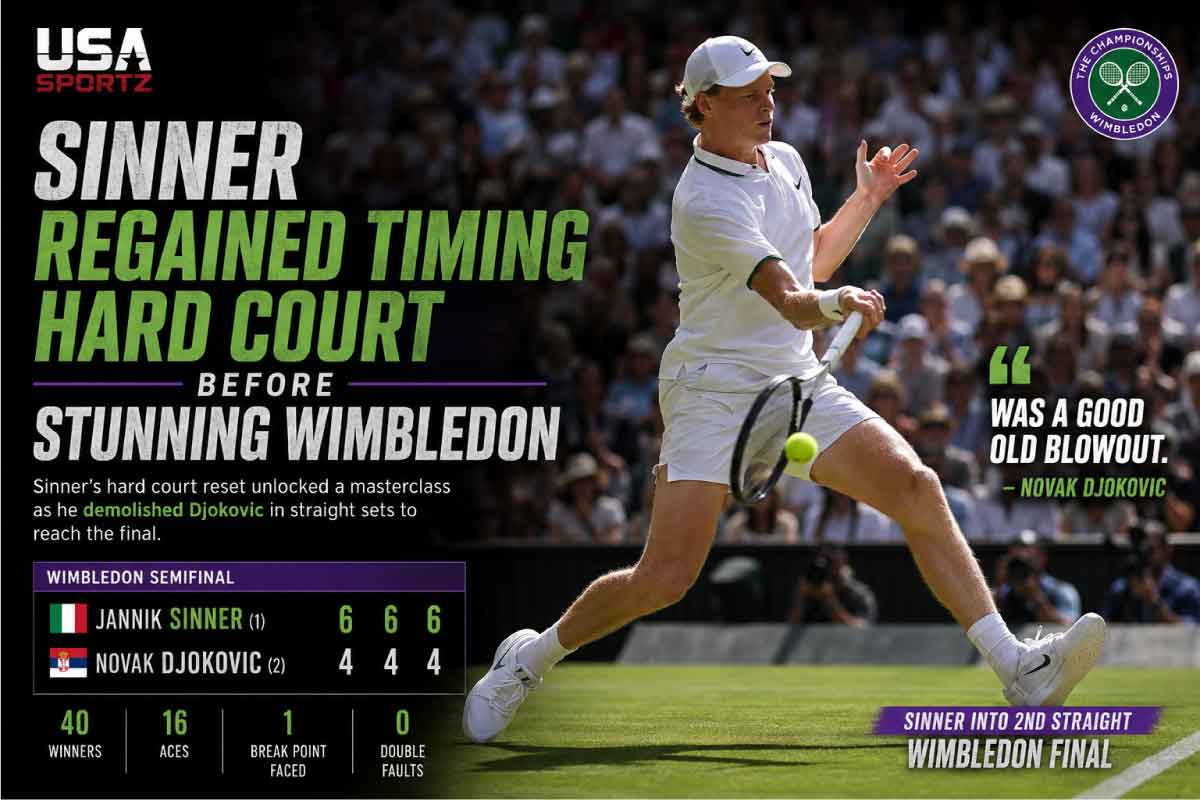
LONDON — Sinner regained timing hard court work paid off in the most emphatic way possible Friday, as Jannik Sinner dismantled seven-time Wimbledon champion Novak Djokovic 6-4, 6-4, 6-4 to reach his second straight final on Centre Court.
The scoreline barely needed context. Sinner faced exactly one break point in two hours and 19 minutes, and answered it with an ace. He struck 40 winners to Djokovic’s 26, committed just 15 unforced errors to Djokovic’s 23, and served 16 aces without a single double fault. Djokovic didn’t dress up what happened. “Was a good old blowout,” he said afterward.
How Sinner Regained Timing Hard Court Work Unlocked
The strange part is that Sinner hadn’t looked anything like this through most of the tournament. He opened the fortnight in a five-setter against Miomir Kecmanovic — rusty, a step slow, nothing like the player who tore off a 30-match winning streak earlier this year. That version of Sinner had disappeared since a stunning second-round collapse at the French Open in a Paris heat wave, and five rounds into Wimbledon, there was no guarantee it was coming back.
Then, on Wednesday, Sinner’s team made an unusual call. Instead of grinding out more grass-court reps in the days before a semifinal against one of the greatest returners the sport has ever produced, Sinner went indoors and practiced on a hard court — the surface where he’s won three of his four Grand Slam titles, and the same type of court he grew up learning the game on. Two days later, the version of Sinner that showed up against Djokovic looked nothing like the one that had needed five sets just to get out of the first round.
Andre Agassi, who won Wimbledon in 1992 playing a similarly aggressive, baseline-hugging style, said on the BBC that the logic tracks completely. Grass forces aggressive players to wait a beat for the ball to sit up, he explained, and over time that hesitation creeps into your swing. Hard courts, by contrast, let a player trust the bounce completely and rediscover what Agassi called “the cleanness of your swing” — exactly the kind of reset Sinner needed heading into his toughest match of the tournament.
Djokovic Had No Answer for What Came Next
Whatever Sinner found on that practice court, it showed up immediately. He broke Djokovic in the ninth game of the first set and served it out clean. Djokovic saved two break points in the fifth game of the second set, but it only delayed things — Sinner broke again for a 4-3 lead and closed out the set with two love holds in a row.
The third set opened with an immediate break, Sinner ripping a backhand past Djokovic to set up the chance. At 2-1, facing his only break point of the entire match with Centre Court roaring for a comeback, Sinner’s response was an unreturnable ace. He never gave Djokovic another opening, serving out the match at love.
Djokovic was blunt in defeat. “I was just half a step late basically on any shot, it’s as simple as that,” he said. “He was just a level or more better than I was. I was just not sharp enough, not reactive enough, not balanced enough to play him.” He also had specific praise for the tool that gave him the most trouble: Sinner’s serve, which Djokovic called nearly impossible to read, with deep placement, heavy rotation, and enough pace that “you cannot attack it.”
What This Win Means Historically
Beating Djokovic in straight sets at a major is rare enough that only two other men in the Open era have done it three times, excluding retirements: Rafael Nadal and Roger Federer. Sinner now joins that list. It was also a measure of revenge — Djokovic had beaten Sinner in five sets in this year’s Australian Open semifinals, and Friday flipped that result entirely, with Djokovic managing to break Sinner’s serve exactly zero times, only the third completed major match of Djokovic’s career where that’s happened.
Sinner has now won 17 consecutive sets since the Kecmanovic scare in the first round, and his serve numbers back up just how dominant that stretch has been — he entered the final as the tournament leader with 113 aces, ahead of finalist Alexander Zverev’s 87.
Up Next: A Rematch Sinner Has Owned
Sinner will face Zverev, fresh off his first career Grand Slam title at the French Open, in Sunday’s final. The head-to-head heavily favors the Italian — Sinner leads 10-4 overall and has won the last nine meetings between the two dating back to the 2024 Cincinnati Open. A win would give Sinner his second straight Wimbledon title and his fifth Grand Slam overall, while also delivering his 100th career major match win, a milestone only a handful of players in the Open era have reached inside a Slam final itself.
For Djokovic, the loss extends a difficult stretch in major semifinals — four of his last six defeats at that stage have now come against Sinner specifically — and pushes his hunt for a 25th Grand Slam title, and an eighth Wimbledon crown to match Federer’s record, into another year. Whatever Sinner regained timing hard court sessions gave him on Wednesday, Djokovic never found a way to slow it down.
The Bottom Line
Two days of hard-court practice turned into the most complete performance of Sinner’s tournament, arriving at exactly the moment he needed it most. Whatever mechanical reset that indoor session provided, it carried him through a legend of the sport without so much as a hiccup — and now Zverev stands as the only man left between Sinner and back-to-back Wimbledon titles.
Why This Detail Matters Beyond One Match
It’s worth sitting with just how unusual this adjustment actually was. Grass-court fortnights are short, and most players treat every practice hour on grass as precious preparation time they can’t afford to give up mid-tournament. Sinner regained timing hard court practice anyway, betting that a temporary break from the surface would pay off more than another day of grass reps against a lesser hitting partner. It’s the kind of decision that only gets remembered if it works — and against a returner as good as Djokovic, it worked about as well as it possibly could have.
That willingness to step away from the obvious preparation path also fits a broader pattern in how Sinner’s team has managed his season. After the French Open collapse, rather than over-correcting by cramming extra grass-court tournaments into the calendar, Sinner skipped grass-court tune-up events entirely heading into Wimbledon for the first time in his career. The early rust against Kecmanovic looked, in hindsight, like the cost of that decision. The hard-court reset before the Djokovic match looked like the correction.
Whether that same blueprint — trusting hard-court instincts to fix a grass-court problem — shows up again before Sunday’s final remains to be seen. But Sinner regained timing hard court confidence just when the tournament demanded his absolute best tennis, and Djokovic, one of the most decorated returners the sport has ever seen, had no answer for it.
FAQ
Q: What was the final score of the Sinner-Djokovic Wimbledon semifinal?
A: Jannik Sinner won 6-4, 6-4, 6-4 in two hours and 19 minutes, facing only one break point the entire match.
Q: Why did Sinner practice on a hard court before playing Djokovic?
A: Sinner’s team had him train indoors on a hard court on Wednesday to help him regain the timing and swing rhythm he’d lost during an inconsistent start to the tournament.
Q: Who does Sinner play in the Wimbledon final?
A: Alexander Zverev, the reigning French Open champion, in Sunday’s final — a matchup Sinner leads 10-4 overall, including the last nine meetings in a row.
Q: How significant was this win for Sinner historically?
A: It made him only the third man in the Open era, after Rafael Nadal and Roger Federer, to beat Djokovic in straight sets at a major three times.